 one
Every cloud kitchen in India needs FSSAI. From 1 April 2026, turnover up to ₹1.5 crore needs Basic Registration (Form A, ₹100 a year). ₹1.5 crore to ₹50 crore needs a State License (₹5,000 a year for a restaurant-type kitchen). Above ₹50 crore, a Central License (₹7,500 a year). Licenses issued from 1 April 2026 don't expire, but the fee is still charged per year. Each kitchen address needs its own license, and you apply on foscos.fssai.gov.in.
You have locked the menu. The packaging looks good. Your Swiggy or Zomato listing is two clicks away. Then the app asks for your 14-digit FSSAI number, and you realise you do not have one.
This happens to a lot of first-time food founders, and the good news is that 2026 has made the whole thing easier than it used to be. The rules changed on 1 April 2026, and most guides online still quote the old numbers. This blog gives you the current picture: which FSSAI license you need, what it costs, which documents to keep ready, how to apply, and what to do after you get it.
What is an FSSAI License?
An FSSAI license is the government permission you need to make, store, sell or serve food legally in India. It is issued by the Food Safety and Standards Authority of India (FSSAI) under the Food Safety and Standards Act, 2006. Once approved, you get a 14-digit number that must be shown on your premises, bills, packaging and online listings. Depending on your yearly turnover and the kind of food business you run, it is issued as a Basic Registration, a State License or a Central License.
In everyday talk, people say "FSSAI license", "food license", "FSSAI registration" and "FSSAI certificate" for the same thing. Strictly speaking, small businesses get a registration and bigger ones get a license. In this blog we use "FSSAI license" for all three, and we point out the difference where it matters.
Quick answer for cloud kitchen owners: If your yearly turnover is up to ₹1.5 crore, you need an FSSAI Basic Registration (Form A, ₹100 a year). Between ₹1.5 crore and ₹50 crore, you need a State License (₹5,000 a year for a restaurant-type kitchen). Above ₹50 crore, a Central License (₹7,500 a year). All applications go through the FoSCoS portal (foscos.fssai.gov.in).
Is an FSSAI license mandatory for a cloud kitchen in India?
Yes. A cloud kitchen has no dining area, but it still cooks, handles and sells food, so it is a food business in the eyes of the law. FSSAI does not have a separate "cloud kitchen" category. A delivery-only kitchen is treated like a restaurant or food service business.
FSSAI's own licensing FAQ answers this directly: cloud kitchens with no seating must take an FSSAI license or registration, based on the same eligibility rules as any other food business.
There is no turnover level below which you are exempt. Even a home chef selling tiffins from a flat in Lajpat Nagar or a weekend baker in Pune needs at least the basic registration. And practically speaking, Swiggy, Zomato and other delivery platforms will not onboard you without a valid FSSAI number.
This isn't just app policy. FSSAI's rules say a platform that lists food businesses may list only those with a valid FSSAI license or registration.
What Changed in FSSAI Rules from 1 April 2026?
Three things changed, and all three help small food businesses. The Food Safety and Standards (Licensing and Registration of Food Businesses) Amendment Regulations, 2026 were notified on 10 March 2026. An FSSAI order dated 13 March 2026 then set the new turnover limits, effective 1 April 2026.
- Higher turnover limits. Basic Registration now covers businesses with turnover up to ₹1.5 crore, up from ₹12 lakh. This is a big deal because most new cloud kitchens fall under this limit.
- Perpetual validity. Licenses and registrations issued on or after 1 April 2026 do not expire, so the old 1 to 5 year renewal cycle is gone. “But read this part carefully: the fee is still charged per year. FSSAI's FAQ of 27 March 2026 says you can pay for any number of years at once, at any time of the year. "No renewal" does not mean "no payment".
- Risk-based inspections. Instead of a one-size-fits-all approach, inspections and audits are now meant to follow the risk level of the business.
| Category | Old turnover limit (till 31 March 2026) | New turnover limit (from 1 April 2026) |
|---|---|---|
| Basic Registration | Up to ₹12 lakh | Up to ₹1.5 crore |
| State License | ₹12 lakh to ₹20 crore | ₹1.5 crore to ₹50 crore |
| Central License | Above ₹20 crore | Above ₹50 crore |
Already hold a license from before April? You don't need to apply again. FSSAI's FAQ of 27 March 2026 says existing businesses move to the new category on FoSCoS based on their own declaration. There's no fee for the change, no approval step, and your license number stays the same. If you were on a State License and now fall under ₹1.5 crore, the fee you already paid is adjusted against the registration fee. Log in and check how your category shows. We can't see your account from here, so check before you assume.
Not sure where your kitchen lands after the change? WhatsApp us your turnover and what you cook, and we'll tell you which category applies.
Types of FSSAI License: Basic Registration vs State License vs Central License
Here is the full picture in one table, followed by a simple visual you can save or share.
| Type | Annual turnover | Form | Government fee (per year) | Who it suits |
|---|---|---|---|---|
| Basic Registration | Up to ₹1.5 crore | Form A | ₹100 | Most single-kitchen startups, home kitchens, small cloud kitchens |
| State License | ₹1.5 crore to ₹50 crore | Form B | ₹5,000 (restaurant-type kitchen) | Growing kitchens, multi-brand setups, caterers (caterers need at least a State License at any turnover) |
| Central License | Above ₹50 crore | Form B | ₹7,500 | Large chains; also any kitchen taking orders on its own website or app, and the head office of a business with kitchens in 2+ states |
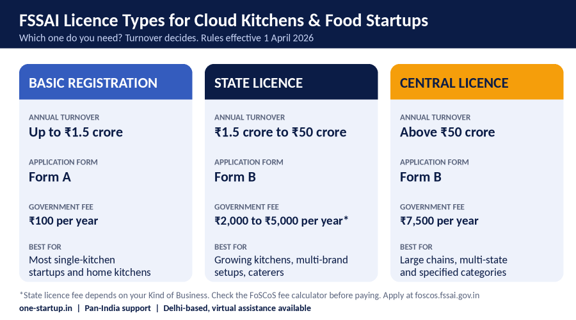
A note on the fee row: on FSSAI's Kind of Business list (updated 1 April 2026), a restaurant-type kitchen pays ₹100 a year for registration, ₹5,000 a year for a State License and ₹7,500 a year for a Central License. Check the fee FoSCoS shows for your exact category before you pay.
Which FSSAI license does your cloud kitchen or food startup need?
Turnover is the main deciding factor, and it is counted for the whole kitchen, not brand by brand. If you run more than one kitchen, each one is judged on its own turnover.
Let us do the maths with two examples.
- Kitchen A: 40 orders a day at an average of ₹300 comes to ₹12,000 a day, or roughly ₹43.8 lakh a year. That is comfortably under ₹1.5 crore, so Basic Registration is enough.
- Kitchen B: 150 orders a day at an average of ₹350 comes to ₹52,500 a day, or roughly ₹1.92 crore a year. That crosses ₹1.5 crore, so this kitchen needs a State License.
A quick way to remember it: ₹1.5 crore is about ₹12.5 lakh of sales a month. If you are crossing that comfortably, plan for a State License.
Two things can push you into a higher category even when turnover is low.
First, your Kind of Business. FSSAI has a list of business kinds, and some, like caterers who serve events, need a State License from day one.
Second, the type of activity. If you also make packaged food for sale, the rules change again. This is where applicants most often pick the wrong category, so check the eligibility list on FoSCoS or ask someone who files these every week.
Which category do you pick on FoSCoS?
Quick Tip: On FoSCoS, a delivery-only kitchen usually applies under Food Service → Restaurants. FSSAI's own description of a restaurant covers places that offer only take-out and delivery. Your turnover then decides the level: registration up to ₹1.5 crore, State License up to ₹50 crore, Central License above that.
Taking orders on your own website or app?
Listing on Swiggy or Zomato doesn't change your category. Selling through your own website or app can. FSSAI's FAQ says a food business selling through its own online platform needs a license under the e-commerce category as well, and on the April 2026 list e-commerce is a Central License (₹7,500 a year) whatever your turnover.
Need a hand choosing? Not sure whether your kitchen is a Basic Registration or State License case? Tell us your model and rough turnover on WhatsApp and we will point you to the right category before you spend a rupee.
FSSAI License for Multi-Brand Cloud Kitchens: One Kitchen, Many Brands
This is the question we hear most from cloud kitchen founders. If you run, say, a biryani brand, a North Indian thali brand and a dessert brand from one kitchen, do you need three licenses?
FSSAI licenses a kitchen premises, not a brand. In 2022 it also said publicly that one cloud kitchen can cook for any number of brands, as long as it follows the food safety rules. So several brands from one licensed kitchen can run under one license. In practice, keep your brand names documented and your product list updated on FoSCoS. You will also see some websites claiming each brand needs its own license. We follow FSSAI's own position here, but we cannot control how a particular local officer or delivery platform reads it, so a paper trail is your best friend.
Two more things to know. Each separate kitchen address needs its own license. A license for your Noida kitchen does not cover the one you open in Gurugram. And aggregators watch kitchens with a very large number of brands closely. Zomato announced manual checks on kitchens running more than 10 brands back in 2022. Since you are building brand names, it is also worth thinking about trademark registration so nobody else can use the name you are investing in.
Opening kitchens in two or more states?
Besides a license or registration for each kitchen, FSSAI requires a Central License for your head office (₹7,500 a year on the April 2026 list). Each kitchen's own category still depends on that kitchen's turnover.
You can explore that how trademark registration works in this blog.
FSSAI License Fees in 2026
These are the government fees, and they are charged per year even though the license no longer expires.
· Basic Registration: ₹100 per year.
· State License: ₹5,000 per year for a restaurant-type kitchen.
· Central License: ₹7,500 per year.
FSSAI's FAQ (27 March 2026) says you can pay for any number of years at once, at any time of the year, which saves you tracking a due date every year. Professional fees, if you take help from a consultant, are separate from these government charges. Always ask for the split in writing, whoever you work with.
Documents Required for FSSAI License for a Cloud Kitchen
The exact list shows on FoSCoS once you select your category, but this is what you should keep ready.
For Basic Registration (Form A):
- Photo ID of the owner or authorised person (Aadhaar, PAN, voter ID or passport) and a passport-size photo.
- Proof of the kitchen premises: electricity bill, rent agreement with the owner's consent, or ownership papers.
- A self-declaration that you follow the basic hygiene and safety standards (Schedule 4, Part I).
- Mobile number and email ID that you actually check, because every update comes there.
For a State or Central License (Form B), you usually add:
- Kitchen layout plan and a list of equipment.
- Food Safety Management Plan, which is a simple written document on how you handle, store, cook and pack food.
- Entity documents if you are a company, LLP or partnership: incorporation certificate or partnership deed, and an authority letter for the person signing.
- Details of your trained Food Safety Supervisor.
- Water test report or other documents, only where your category or state asks for them.
The premises proof is where most of the time gets lost. If you are in a rented space, a shared commercial kitchen or a co-working food hub, get the owner's consent paper sorted early. It is not something we can speed up for you, because it depends on your landlord.
Haven't decided whether the kitchen runs as a proprietorship, LLP or company yet? Settle that first, because the entity documents above change with it. Here's which business structure suits you.
How to Apply for an FSSAI License Online: Step-by-Step Process
- Find your category. Check your Kind of Business and estimated annual turnover to see whether you need Basic Registration, a State License or a Central License.
- Collect your documents. Scan them clearly. Blurry uploads are a common reason for queries.
- Create your login on FoSCoS. Visit foscos.fssai.gov.in, register with your mobile number and email, and start a new application.
- Fill in Form A or Form B. Enter your business details, premises address, food products and brand names carefully. The name on your ID and your business papers should match.
- Upload documents and pay the fee. Pay online and save the receipt.
- Wait for scrutiny. The authority reviews your application. For some applications an inspection is ordered, more often for State Licenses.
- Receive your certificate. Once approved, you get your 14-digit FSSAI number and certificate. Download it immediately and keep a copy on your phone.
- Display it. Put the number on your kitchen premises, packaging, bills and every delivery app listing.
How long does it take? Honestly, it varies.
FSSAI's March 2026 announcement says businesses in the registration bracket now get faster registration, with no pre-inspection. State Licenses take longer, especially if an inspection is ordered. Under FSSAI's rules, a license has to be issued within 60 days of a complete application.
Processing speed depends on the local food safety office and, yes, on how many queries are raised. We can control how complete your application is. We cannot control how fast a state office responds, and anyone who promises an exact date is guessing.
Other Licenses a Cloud Kitchen Needs Along with FSSAI
FSSAI is the most important one, but it is not the only one. Depending on your city, building and turnover, you may also need:
- GST registration. Whether it is mandatory depends on your turnover and how you sell. Read about GST registration or ask us to check your case.
- Shop & Establishment registration under your state's law. Rules differ by state, so see our page on Shop & Establishment registration.
- Trade or health license from your local municipal body, such as MCD in Delhi, BMC in Mumbai or GHMC in Hyderabad.
- Fire safety NOC, but only where your premises size, building type and state rules call for it. It is not automatic for every kitchen.
- Udyam (MSME) registration, which is optional and free on the government Udyam portal, and can help with loans and schemes. Here's our Udyam registration guide.
License comparison table
| License | Needed? | Where you apply |
|---|---|---|
| FSSAI | Yes, every cloud kitchen | FoSCoS (foscos.fssai.gov.in) |
| GST registration | Depends on your turnover and how you sell | GST portal (gst.gov.in) |
| Shop & Establishment | Depends on your state's law | Your state labour department |
| Trade or health license | Depends on your city | Your municipal body (MCD, BMC, GHMC…) |
| Fire safety NOC | Only where premises size, building type or state rules call for it | State fire department |
| Udyam (MSME) | Optional, free | udyamregistration.gov.in |
Local rules vary a lot from one city to another, and that is the part no national guide can fully cover. Always check with your municipal office too.
FSSAI Compliance Roadmap After You Get the License
Getting the certificate is the start, not the finish. Here is a simple roadmap.
- Week one: Display the license number at your premises, on packaging, bills, menus and delivery platform listings. Store a digital copy of the certificate.
- Every year: The fee is still charged per year, even though the license doesn't expire. Pay it on FoSCoS, or pay for several years at once so you aren't tracking it every year.
- Annual return: Form D1 is due by 31 May each year, but only for manufacturers (including repackers and relabellers), importers and manufacturer-exporters. A cloud kitchen that only cooks and delivers doesn't file it. If you also make packaged food for sale, you may have to, and the late fee is ₹100 a day from 1 June.
- Staff training: Licensed premises need a trained Food Safety Supervisor under FSSAI's FoSTaC programme, generally one per 25 food handlers. Even if you only hold a Basic Registration, getting your head cook trained is a smart move.
- Daily hygiene records: Keep simple logs for cleaning, pest control, storage temperatures, staff health and water quality. Schedule 4 of the licensing regulations sets the hygiene standards (Part V covers catering and food service).
- Keep details updated: New brand, new product line or new address? Update FoSCoS. A kitchen that quietly adds brands on delivery apps without updating the license is asking for trouble.
- Be inspection-ready: Under the risk-based framework, an officer can visit. Clean premises, records on hand and a visible license number go a long way.
Penalty for Running a Food Business without an FSSAI License
If your kitchen needs a State or Central License and runs without one, Section 63 of the Food Safety and Standards Act, 2006 allows imprisonment of up to 6 months and a fine of up to ₹5 lakh. Running without even a Basic Registration is also against the law. Delivery platforms can also delist you quickly. Penalties for selling unsafe food are separate, and heavier. For a ₹100 registration, that is a very expensive gamble.
FAQs
Frequently asked questions
Yes. Every cloud kitchen in India needs an FSSAI Basic Registration, State License or Central License, depending on turnover and Kind of Business.
Up to ₹1.5 crore turnover, Basic Registration. From ₹1.5 crore to ₹50 crore, State License. Above ₹50 crore, Central License. These limits apply from 1 April 2026.
Yes. FSSAI licenses the kitchen premises, and in 2022 it said one cloud kitchen can cook for any number of brands if it follows the rules. Each separate kitchen address needs its own license. Keep your brand and product list updated on FoSCoS.
No. Licenses and registrations issued on or after 1 April 2026 have perpetual validity. The fee is still charged per year, and you can pay for several years at once.
The government fee is ₹100 per year for Basic Registration, ₹5,000 per year for a State License (restaurant-type kitchen) and ₹7,500 per year for a Central License.
Yes. A home-based food business with turnover up to ₹1.5 crore can apply for Basic Registration. Keep your premises proof ready, and check any rules of your housing society or local body as well.
No. Delivery platforms ask for a valid 14-digit FSSAI number before they list a kitchen.
It depends on your category, state, and whether an inspection is ordered. Basic Registration is usually quicker than a State License.
On the official FoSCoS portal at foscos.fssai.gov.in. You can apply yourself, or take professional help for document checks and filing.
Usually Food Service → Restaurants. FSSAI's description of a restaurant includes kitchens that only do take-out and delivery. Turnover then decides registration, State or Central.
No. The Food Safety and Standards Act says no one can start or carry on a food business without an FSSAI license or registration. Apply first, and go live once your 14-digit number is issued.
What should you do next?
If your kitchen is under ₹1.5 crore turnover and cooks from one address, apply for Basic Registration on FoSCoS before you list on any delivery app. If you're above that, run more than one kitchen, or take orders on your own website, check your category first, because the wrong one means applying again.
You can file this yourself on FoSCoS. If you'd rather have your category and documents checked before you file, that's what we do. → one-startup FSSAI registration
Get your Food Business Legally Ready with one-startup
Most food founders we talk to are brilliant at food and a little lost with forms or legalities. That is completely normal. You should be spending your energy on recipes, packaging and customers, not on decoding a government portal at 11 pm.
At one-startup, we help small and growing food businesses across India sort out their FSSAI license, GST, Shop & Establishment and other registrations, from a single-kitchen startup to a multi-city brand. We check your details before filing, explain what each step means, and tell you what comes next so your certificate is not a dead end. Our team is based in Noida, we support businesses in every state, and everything can be handled virtually, so it does not matter whether you are in Jaipur, Kochi, Guwahati or Indore.
You can file this yourself on FoSCoS. If you'd rather have your category and documents checked before you file, that's what we do. → one-startup FSSAI registration
And you can directly reach out to us over whatApp or call and a professional will help you to move ahead rather than just to stuck in DIY loop.
Official resources
| Official source | Use it for | Link |
|---|---|---|
| Food Safety and Standards Act, 2006 | Section 31 (license/registration), Section 63 (penalty) | https://fssai.gov.in/upload/uploadfiles/files/FOOD-ACT.pdf |
| FSSAI order, 13 March 2026 | New turnover limits from 1 April 2026 | https://www.fssai.gov.in/upload/advisories/2026/03/69b4054bb6cd6Order%20dated%2013thMarch2026_Revised%20Turnover%20threshold.pdf |
| FSSAI FAQs, 27 March 2026 | Perpetual validity, fee years, migration | https://fssai.gov.in/upload/advisories/2026/03/69c6a23234827order_27032026.pdf |
| FoSCoS Kind of Business list (updated 1 April 2026) | Your category and annual fee | https://foscos.fssai.gov.in/assets/docs/Revised_2ndApril2026KindofBusinessEligibility.pdf |
| FSSAI advisory on annual returns (16 April 2024) | Who files Form D1, due date, late fee | https://fssai.gov.in/upload/advisories/2024/04/661e73c35373eRevised%20annual%20return.pdf |
| FoSCoS portal | Apply, pay fees, update your license | https://foscos.fssai.gov.in/ |
Disclaimer: This blog is for general information and is accurate as of 30 October2026. FSSAI rules, fees and procedures can change, and some requirements vary by state. Please confirm current details on FoSCoS or with a professional before filing. one-startup is a private consultancy and is not affiliated with the Government of India or FSSAI.
Last updated: October2026