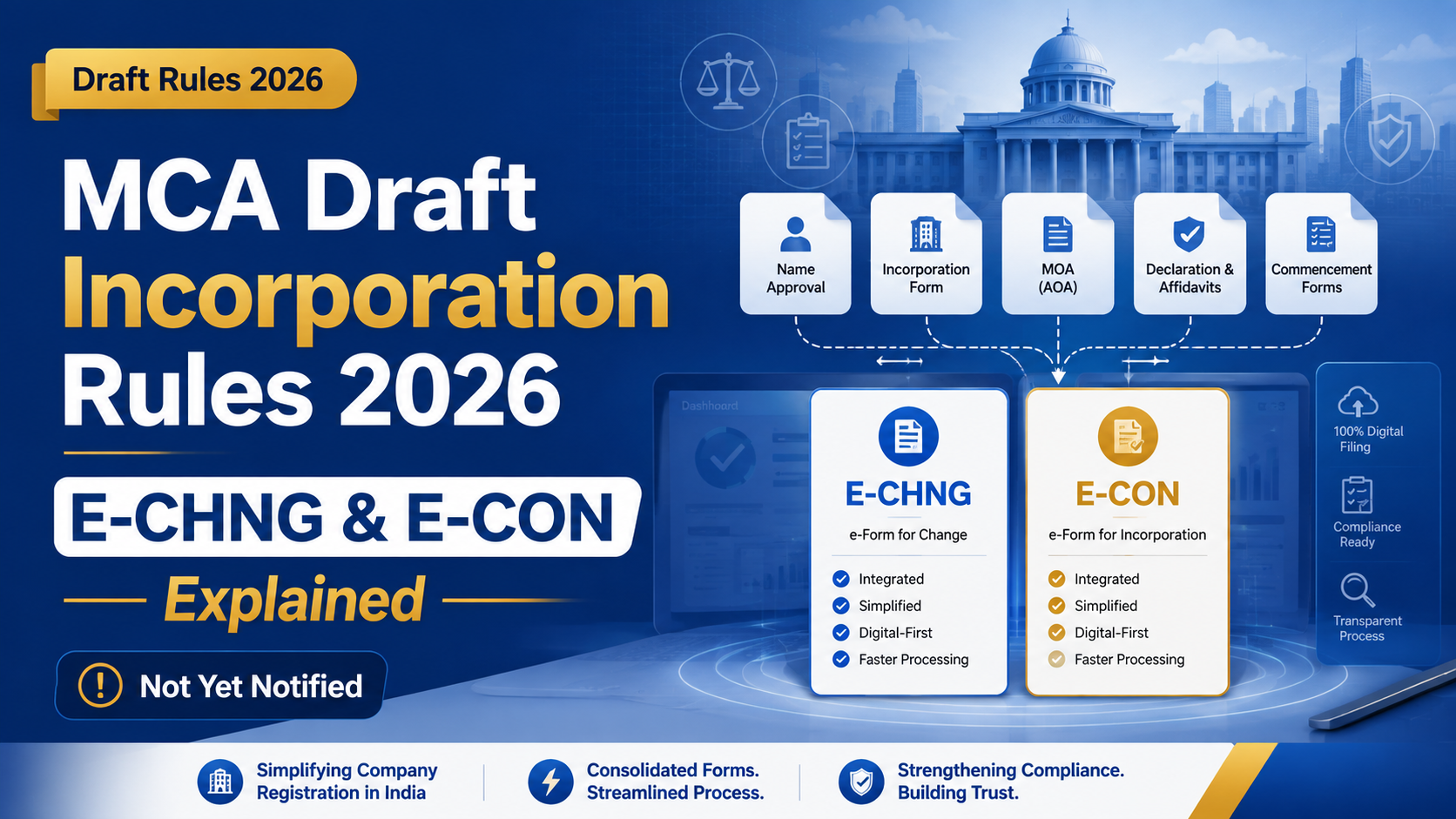
MCA Draft Incorporation Rules 2026: E-CHNG and E-CON Explained
At a Glance
The MCA Draft Incorporation Rules 2026 propose consolidating several company filing forms into E-CHNG and E-CON. They also propose OPC relaxations, a higher DIN allotment limit, OTP-based director consent and simpler incorporation procedures. As of August 2026, the rules are still in draft, so companies must continue using the existing MCA forms.
MCA Draft Incorporation Rules 2026: E-CHNG and E-CON Explained
What the MCA's 8 April 2026 draft proposes to change for company registration in India, covering the new E-CHNG and E-CON forms, OPC relaxations, and what still applies while the rules await gazette notification.
If you've shifted a registered office or changed a company name, you know how the paperwork goes. One form for the office. A different one for the name. A third if you're converting an OPC into a private limited company. Same details, typed again each time.
On 8 April 2026, the Ministry of Corporate Affairs published a draft notification proposing to fix a good part of that. It's called the Companies (Incorporation) Amendment Rules, 2026, and it amends the Companies (Incorporation) Rules, 2014.
Here's the part that matters most, and most articles bury it: as of August 2026, these rules are still not notified in the Official Gazette. Nothing has changed for your filings yet. Keep reading for what's coming, but don't change how you file this week.
What did MCA actually propose on 8 April 2026?
MCA issued a public notice and explanatory note proposing amendments to the Companies (Incorporation) Rules, 2014, under policy reference CL-V Section, Policy-01/2/2025-CL-V-MCA-Part(2). The headline change merges several incorporation forms into two modular e-forms, E-CHNG and E-CON.
The goal: cut duplication, reduce paperwork, and push India's company registry further into a paperless, digital-first system. Comments were invited through the MCA e-Consultation Module until 9 May 2026.
The comment window closed over three months ago. There's no final notification yet.
Which forms merge into E-CHNG and E-CON?
MCA's notice frames this as nine forms becoming two. Several published summaries list eleven. Both counts appear in circulation, so here's the full picture in one place.
| New form | Absorbs | Covers |
|---|---|---|
| E-CHNG | INC-4, INC-22, INC-23, INC-24 | Registered office changes and company name changes |
| E-CON | INC-6, INC-12, INC-18, INC-20, INC-27, INC-28, RD-1 | Conversions, Section 8 licensing, and Regional Director approvals |
The nine MCA counts are INC-22, INC-23, INC-24, INC-6, INC-12, INC-18, INC-20, INC-27 and RD-1. Add INC-4 and INC-28, which several summaries include, and the working total reaches eleven. If you see both numbers quoted, that's why. Neither is wrong; they're counting different lists.
E-CHNG is modular. Instead of working out which of four forms applies, you pick the part that matches your situation. Fewer wrong-form rejections, in theory.
E-CHNG Form: One Form Instead of Four for Office & Name Changes
If your company ever needs to shift its registered office or change its name, you currently juggle four separate forms — INC-22, INC-23, INC-24, and in some Regional Director matters, RD-1. The draft rules merge all of this into a single modular form called E-CHNG, split into parts (Part A for office changes within local limits, Part B for changes outside local limits, Part C for name changes, and so on). You simply pick the module that fits your situation instead of hunting down which of four forms applies. Fewer forms usually means fewer rejections too — a lot of ROC queries today come from founders filing the wrong form or missing a cross-reference between related filings.
E-CON Form: One Form for Conversions, Approvals & Orders
The second big merger is E-CON, proposed to absorb INC-6 (OPC to private company conversion), INC-12 (Section 8 company licence), INC-18 and INC-20 (unlimited-to-limited conversions and related orders), INC-27, and RD-1/INC-28. If you're converting entity types — say, moving from an OPC to a Private Limited Company as revenue grows — this is the single form you'll eventually file instead of hunting through three or four formats. Companies that go through more than one conversion in their lifetime (plenty do, especially once they cross the OPC turnover threshold) could genuinely save time from FY27 onward.
At one-startup, we already track which of these forms applies to which entity type across our clients — so when the switchover happens, it's one less thing you'll need to figure out on your own.
What changes for One Person Companies?
This is the change solo founders should read twice.
Converting into an OPC currently requires directors to submit an affidavit. Notarisation, attestation, a trip you didn't budget for. The draft proposes removing that requirement.
Today, an OPC that crosses ₹50 lakh in paid-up capital or ₹2 crore in average annual turnover across three consecutive financial years must convert to a private limited company.
More importantly, the draft also proposes dropping the criminal liability provision tied to certain OPC compliance defaults. Many first-time entrepreneurs don't realise that missing an OPC conversion deadline can, technically, invite criminal liability today — a disproportionate consequence for what is usually a missed paperwork deadline, not fraud. If this survives to final notification, the OPC becomes a considerably safer structure than it is today. Worth knowing if you're weighing how to register a One Person Company in India.
What else is in the draft?
A few smaller proposals don't get the headlines but make incorporation noticeably less painful:
- DIN cap raised from 3 to 5. You can allot Director Identification Numbers for up to five proposed directors at incorporation, which helps larger founding teams.
- OTP-based director consent. An OTP mechanism replaces paper consent forms, with DIR-12 proposed for omission and deemed consent for MoA subscribers.
- AGILE-PRO-S made optional. Right now, EPFO, ESIC and bank account registration bundle in at incorporation whether or not you need them on day one. The draft lets you pick.
- Rule 8 rewritten. Name-similarity checks move to table-based criteria with examples of undesirable names, replacing a process that currently depends on the officer reviewing it. This changes the framework behind our existing MCA company naming guidelines.
- New Rule 23B. Covers unpaid shares where an MoA subscriber dies before incorporation, a gap that had no clear answer.
Quick Tip: If a name change or office shift is on your plate in the next few weeks, file it now on the current forms. A filing already in progress under known rules beats one caught mid-transition.
Should you wait for the new rules before registering?
No. Register today using the current forms. The existing rules stay fully valid until MCA publishes the final gazette notification, and if anyone tells you E-CHNG or E-CON are live right now, they aren't. Our step-by-step company incorporation guide reflects what actually applies.
A More Urgent Deadline: CCFS-2026 Closes 31 Aug 2026
While the incorporation rules wait, a different scheme is running out.
The Companies Compliance Facilitation Scheme, 2026 (CCFS-2026) came into force on 15 April 2026 under General Circular No. 01/2026 dated 24 February 2026. Eligible companies clear pending annual filings by paying the normal fee plus only 10% of the additional fee, instead of the usual ₹100 per day per form.
It was due to close 15 July 2026. MCA extended it to 31 August 2026 through General Circular No. 03/2026 dated 8 July 2026, after a fire at the MCA data centre on 5 June 2026 disrupted MCA21 during peak filing season.
That leaves under two weeks. If you have a filing backlog, this matters more today than anything in the draft rules. Full detail in our CCFS-2026 scheme guide.
When will E-CHNG and E-CON actually apply?
| Date | What happened |
|---|---|
| 8 April 2026 | Draft notification published by MCA's CL-V Section |
| 9 May 2026 | Public comment window closed |
| August 2026 | Still not gazetted |
| TBD | Final rules published; E-CHNG and E-CON go live on MCA V3; old forms retired |
one-startup can help you check whether your company qualifies for CFSS 2026 while you're at it — it often takes just one conversation to know
Message us on WhatsApp us or on +91 7055107773 and we'll tell you exactly what applies to you.
Phone: +91 7055107773.
Email: contact@one-startup.in
Related reads
- How to register a One Person Company in India
- Company incorporation: a step-by-step guide
- MCA CCFS-2026 scheme for pending statutory filings
Official resources
| Source | Use it for |
|---|---|
| mca.gov.in | Draft notification, circulars, and current filing status |
| MCA e-Consultation Module | Where comments on draft rules are submitted |
| MCA V3 portal | Live forms and filing |
Compliance requirements are subject to change. The proposals described here are in draft form and not in force. Verify the current position on mca.gov.in or consult a CA/CS before relying on any specific provision.
Last updated: August 2026
FAQs
Straight answers to the questions people ask before they get started.
No. They were published on 8 April 2026 for public consultation and have not been notified in the Official Gazette as of August 2026. All current forms and procedures remain valid.
E-CHNG is the proposed consolidated form for registered office changes and company name changes. Once notified, it replaces INC-4, INC-22, INC-23 and INC-24.
E-CON is the proposed form for conversions and approvals, covering OPC-to-private conversion, Section 8 licensing and Regional Director matters. It replaces INC-6, INC-12, INC-18, INC-20, INC-27, INC-28 and RD-1.
MCA's notice describes nine. Summaries that also count INC-4 and INC-28 arrive at eleven. Both figures refer to the same proposal.
The draft proposes removing the affidavit requirement for OPC conversion and dropping the criminal liability provision attached to certain OPC compliance defaults.
Not necessarily. You can register today using current forms — no need to pause your plans for a draft that isn't finalised. Do check with a professional if an OPC conversion, name change, or office shift is coming up, so your paperwork transitions smoothly once the final rules take effect.